

Deployment Models
Understand the three deployment models Granica supports and what data flows out of your cloud environment in each.
Granica supports three deployment models. This page describes each model and what data, if any, crosses your cloud boundaries — helping your InfoSec team understand the design and accelerate approvals.
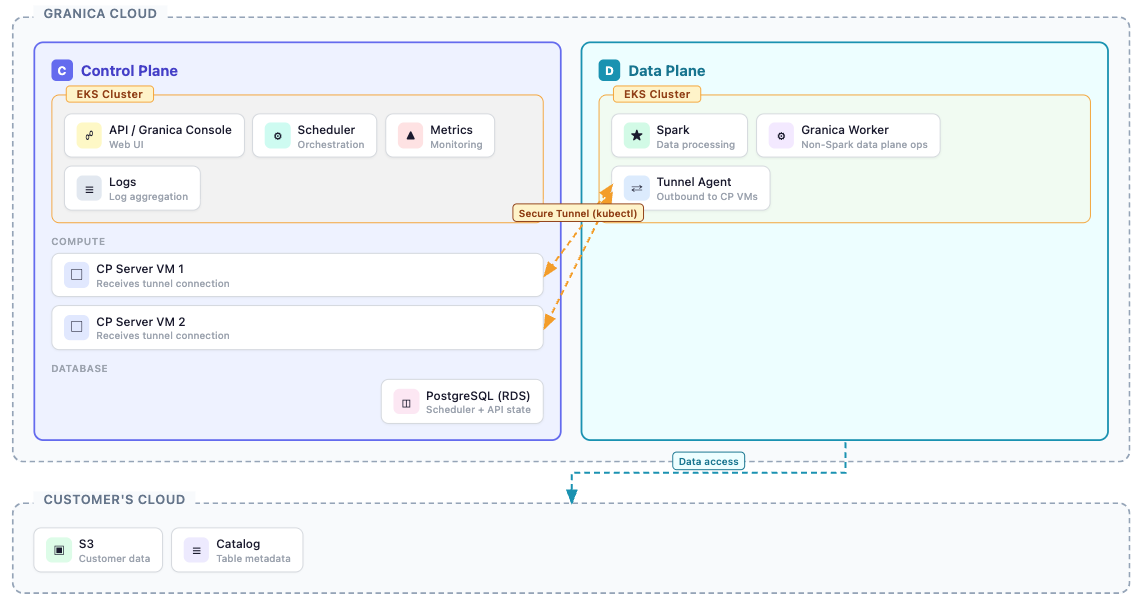
Model 1 — Granica Hosted
In the Granica Hosted model, Granica manages the platform infrastructure on your behalf. Customers' data objects and catalog metadata flow in and out of the customer's cloud as part of normal Crunch operations.
Data that leaves your cloud: table data and catalog metadata.
Model 2 — On-Premises
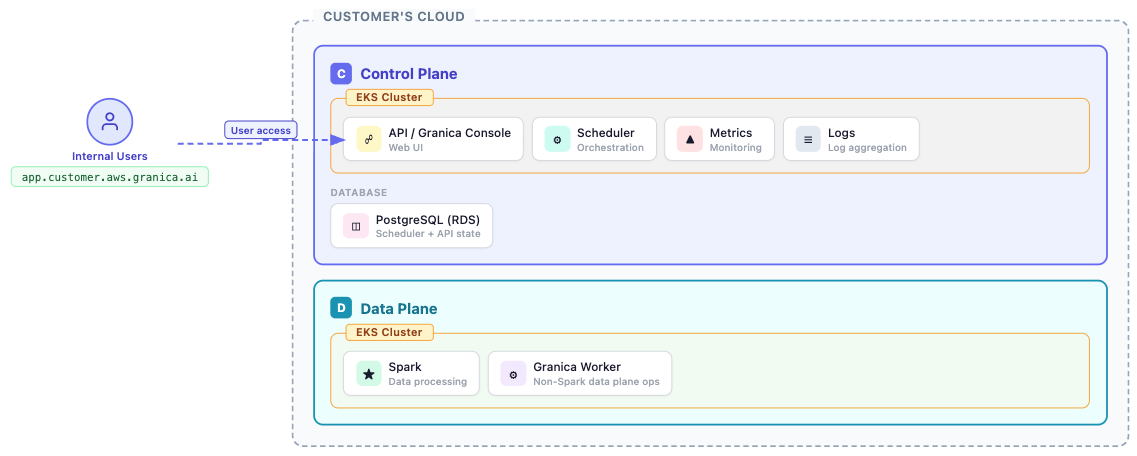
In the On-Prem model, the Granica platform runs entirely within your cloud environment. No payload crosses your cloud boundaries.
Nothing leaves your cloud. Not only your table data, but also your catalog metadata, logs, and metrics stay entirely within your cloud environment.
Model 3 — Hybrid
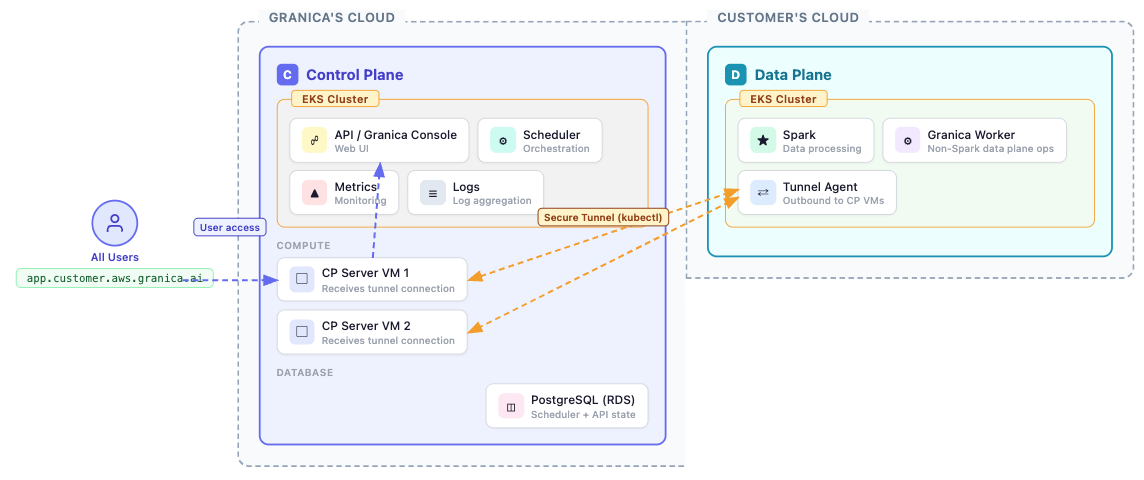
Data that flows out of your cloud includes Spark job progress (e.g. numCompletedTasks), job status (e.g. RUNNING), failures (e.g. OutOfMemoryError), and performance metrics.
Actual table data does not leave your cloud.
Comparison
| Pros | Cons | |
|---|---|---|
| Granica Hosted | Minimal permissions required (data/catalog read/write only); no infrastructure bandwidth needed from customer; Crunch compute cost borne by Granica | Data travels outside the customer environment, which may require InfoSec review |
| On-Premises | No data leaves the customer cloud — not even logs or metrics | Requires customer infrastructure deployment and ongoing maintenance |
| Hybrid | No actual table data leaves the customer cloud; only metadata and metrics are shared | — |
Start a Crunch pilot
Experience the savings potential of Crunch using a sample of your data.
AWS
Set up and deploy a Granica Admin Server on AWS using Terraform.